Grief, loss and other subjects explored by Tusculum students and alumni in journal dedicated to Pioneer who died
GREENEVILLE – High-caliber writing that expounds on a variety of subjects, particularly grief and loss, along with multiple pieces of art fill the pages of the newest edition of a student-run journal at Tusculum University.
“Sit Lux,” an annual production of the Tusculum’s English program, was recently published, featuring mostly the work of Tusculum students but also encompassing items from alumni, a professor and the university’s president. A student team led the process of creating the publication with assistance from faculty in Tusculum’s English and art and design programs.
The students dedicated this issue to the late Payton Cook, a freshman in the business administration program and a member of the Tusculum Pioneers men’s lacrosse team, who passed away in December in a car accident near campus.
“The journal began as a dedication to Payton Cook, so one of my primary goals, along with the broader goals of the editorial team, was to create an edition that honored his memory while also capturing and showcasing the voices and work of student artists and writers,” said JP Campione, a junior who served as co-editor-in-chief. “We also wanted the journal to feel meaningful and cohesive, while still allowing each piece to stand on its own and contribute to the overall themes of the issue.”
Lily Burgner, a junior who served as the other co-editor, had similar feelings about Cook, but she recognized his passing had a broader scope.
“In my eyes I did not see Payton as the only victim,” she said. “Everyone in that car was hurt, everyone close to him was hurt, everyone who knew him was hurt. I wanted to give everyone a chance to express those feelings. One thing I always advocate for is the expression of emotions no matter what they are. It is OK to feel sad or hurt or angry, and I don’t think that is recognized enough.”
The other members of the editorial staff were Haley Alexander, editor; Isabella Gall, art editor; and Kiersten Paxton, prose editor.
The initial pages of “Sit Lux” discuss Cook’s passing. Dr. Scott Hummel, Tusculum’s president, wrote the foreword and highlighted the importance of community, quoting from Genesis: “It is not good that man should be alone.” He shared how he, the lacrosse players and coaches and the campus minister drew strength from each other in the immediate aftermath of the fatal accident.
He said the Tusculum family came together in a special way at the memorial service three days later. Community was also evident when the players attended Tusculum Baptist Church two days after the accident.
The journal also includes a portion of an essay called “The Best Decision of My Life” that Cook wrote for a class taught by Holly Ratcliff, assistant professor of English. In the piece, read by Ratcliff at the memorial service, Cook shares that one of his best decisions was to give his life to Jesus. He described feeling broken, alone and melancholy until someone suggested he pray, and when he took the advice, it turned around his life.
“In my day-to-day life, I try to live by his name and his ways and not by my own,” Cook wrote. “Keeping Jesus’ name in my head serves as a reminder that he is the quintessential meaning of love and charity. There is so much hate in today’s society, so if I can be the reason someone’s day is even the slightest bit better, then that makes my day much better.”
Ratcliff, who also spoke at the service, contributed an essay for “Sit Lux” that touched on grief. She also discussed in detail C.S. Lewis’ “A Grief Observed” and Question 38 of St. Thomas Aquinas’ “Summa Theologica.”
“If there is one thing we know for certain, it is that at some point in our lives we will experience grief,” Ratcliff wrote. “However, we experience grief, or however we respond to loss, we must know that others around us are frequently doing the same thing in different ways every day. There is no one required method or approach to handling the loss of a friend, a parent, a sibling, a loved one. There is no perfect way through grief.”
The remainder of “Sit Lux” includes a winning entry from the Curtis ’28 and Billie Owens Literary Prize ceremony in April. That was student Kiersten Paxton’s nonfiction essay “Holy Ground,” which examines the different ways she has experienced grief and the way the stereotypical version of that emotion does not apply in many cases.
Among the other items in the journal are a play, “An Eye for Love,” from student Michael Bumgarner, who is heavily involved in theater productions at Tusculum, and nonfiction profiles of poet Nate Marshall and Tusculum alumnus Bill Edmonds, who was the featured speaker at the African American Read-In on campus in February, that were written by student Beth Hixson and Campione, respectively.
Student Izzy Wilson wrote about her experience creating and acting in the play “Morella,” while dealing with personal matters. Student Jerry Ricker developed a fictional story about a trip by a man and his son and the conversations and silence between them. Classmate Austin Reed contributed a nonfiction story, “A Leap,” about his parents growing in their faith and walking with God.
Additionally, student Bob Schaff and alumnus Paul Lawless contributed the poems “French Broad River” and “You and Me Became We,” respectively. Lawless also submitted the nonfiction piece “Four Memories of Tusculum.”
“You came without a warning,” Schaff’s poem begins. “No one knew your name. From the Gulf, it began storming, manifested a hurricane. Catastrophic destruction, all we knew is gone. Many lives disrupted. Others met God. Overflowed through the valley with no remorse. Volunteers rallied, traveling your own course. Many abandoned and soured, obliteration you have devoured.”
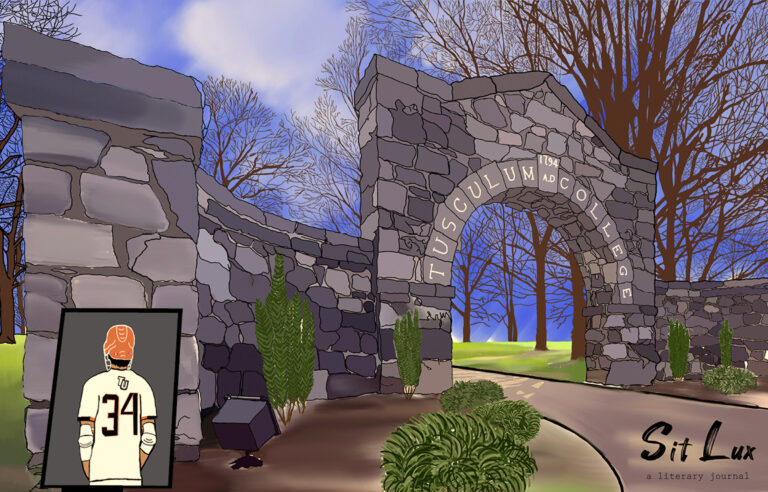
This edition also touted art in various media, which was presented in full pages from students Sophia Derrick, Cheyenne Hewitt, Hannah Morgan, Olivia Nanney and Mirissa Walters as well as alumna Lilli Gall. The cover, which shows the iconic Tusculum Arch, was the work of student Sage Clapp, who worked closely with Ben Conley, assistant professor of art and design. Morgan designed the “Sit Lux” logo.
“Sit Lux” is Tusculum’s motto and is translated into English as “Let there be light.” Dr. Travis Williams, professor of religion, highlighted the phrase’s connection to Genesis 1:3 and discussed the importance of light for ancient peoples and the perspectives of philosophers.
“The fact that Tusculum’s motto is ‘Sit Lux’ signals more than the acquisition of information,” Dr. Williams said. “It points toward the disciplined pursuit of clarity. Illumination, in this deeper sense, requires careful attention to context, evidence and argument. It calls for the patient work of distinguishing what is persuasive from what is merely asserted.”
Campione, who is seeking a degree in English with a concentration in creative writing, said all of the works had their own flavor. He is proud of each one. He did highlight “Holy Ground” for touching on grief, “Morella” for tackling the idea coming of age, “A Leap” for its connection to community and “An Eye for Love” for addressing coming of age and community. He said the subject matter in these four pieces aligned with themes for the magazine.
Serving as leaders for “Sit Lux” provided value for Campione and Burgner.
“Working on this edition of ‘Sit Lux’ has taught me many valuable lessons, not only about the process of editing and compiling a literary journal, but also about collaboration and personal growth,” Campione said. “Being part of a team working toward deadlines on a project like this really encourages growth and nurtures skills that will be useful in any future academic or professional setting. Whenever I had questions or was unsure about something, someone was there to offer guidance and support. The process felt very collaborative, we all helped each other, often taking on tasks beyond our specific roles.”
“I really enjoy managerial tasks,” said, Burgner, who is pursuing a degree in history with a concentration in museum studies. “I like organizing, making spreadsheets, handling communication, making thank you cards and completing other tasks. That is where I thrived in this project. When it came to making the weekly agendas, I was all over that. I did a lot of the basic fundamentals.”
Kelsey Trom, professor of English and the Harriet Reaves Neff Chair of Fine Arts, praised the “Sit Lux” student leaders. She touted Gall’s design as fresh and appealing “These are truly remarkable student editors, with great individual tenacity, thoughtfulness, diplomacy and meticulousness,” she said. “Together, they had the chemistry and follow through of any great design team. JP and Lily were great co-editors. At some point, someone said to me, ‘This is a student journal, so people don’t expect it to be perfect.’ I must have reared back, and I think I said, ‘Oh no. In this department, we aim for excellence. We’re publishing this with faculty donations–it’s going to be top-flight.’” Trom cited other elements of “Sit Lux” that stood out to her.
“I’m so impressed by the coherence, quality a variety of the writing and art here,” she said. “I also like that the writers featured here are not just English majors. We have fiction by sport science and sport management students, journalism and nonfiction by communication major, and poetry by an education major.”
In addition to Trom, faculty advisors were Ratcliff, Dr. Anne Acker, Chris Allen and Dr. Laura Sterrett.