As lake season arrives, Mills enlists governor to help raise ESD awareness

It was July 4. 2012.
A couple of Lakeway Area families were enjoying the holiday from a boat docked at a marina in Cherokee Lake.
If you lived here at the time, you know what happened next and its unlikely you’ll ever forget it. .
A couple of fifth graders, Noah Winstead and Nate Lynam, jumped in the water and contacted a stray current of electricity, coming from the dock or marina.
The boys were shocked by the current, their bodies unable to swim. The both died from Electric Shock Drowning. For many of us, it was the first time we’d ever heard of such a thing.
Now, as the 14th anniversary of that tragic day approaches, Noah’s mother Jessica Mills is taking the opportunity this Memorial Day Weekend, the traditional start of summer lake season, to remind others of the dangers of ESD, swimming near or around marinas and docks and the importance of dock and marina owners to follow the law created in honor of the two young men.
What is Electric Shock Drowning?
According to the website www. electricshockdrowning.org, ESD is “the result of the passage of a typically low level AC current through the body with sufficient force to cause skeletal muscular paralysis, rendering the victim unable to help himself / herself, while immersed in fresh water, eventually resulting in drowning of the victim. Higher levels of AC current in the water will also result in electrocution. Electric Shock Drowning (ESD) has become the catch all phrase that encompasses all in-water shock casualties and fatalities.
“Although Electric Shock Drowning can occur virtually in any location where electricity is provided near water, the majority of Electric Shock Drowning deaths have occurred in public and private marinas and docks. The typical victim of Electric Shock Drowning is a child swimming in or around a marina or dock where electricity is present. The electricity that enters the water and causes Electric Shock Drowning originates from the wiring of the dock or marina, or from boats that are connected to the marina’s or dock’s power supply.”
Meeting with the governor
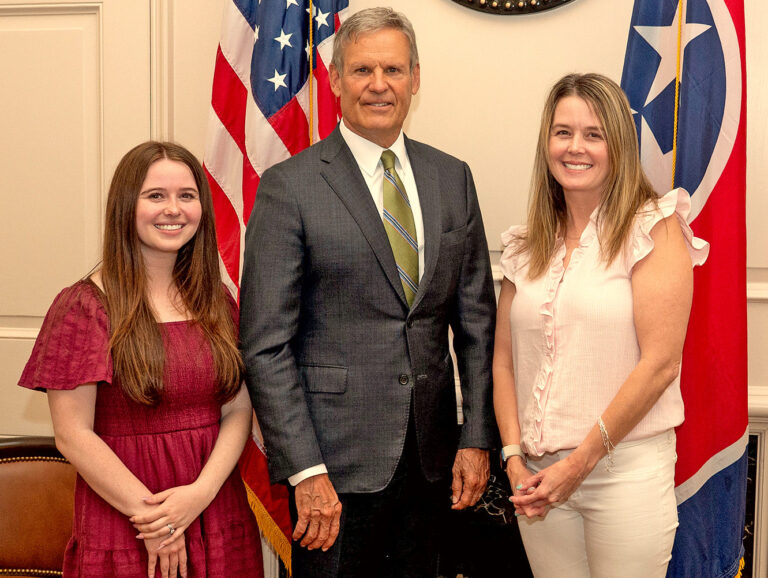
Mills met with Tennessee Gov. Bill Lee in hopes of spreading awareness. The tragedy of the boys’ deaths and the subsequent efforts to keep their memory alive means that the Lakeway Area is fairly well versed in the dangers of ESD.
But Mills – who led the efforts to get the Noah Dean and Nate Act passed – is working to raise awareness across the state and beyond.
With Lee’s tenure coming to an end and his effort to reach every county in the state before he leaves office, Mills through it was a good time to reach out and ask him to help spread the work.
“Before he left office, we could do another PSA with him and I was able to get in with the governor and reiterate to him about ESD,” she said. “As he’s making his way across the state he can educate about lake safety and Electric Shock Drowning. There’s a bigger audience I want to reach.”
Mills, who is a vice president with the ESD website, said Tennessee was relatively quick to respond and the state’s measure – while not perfect – was an important step in raising awareness and making Tennessee’s lakes safer.
However, she said she has been dismayed that other states have been slow to step up and in some cases slow to ever recognize deaths as being connected to ESD.
She said there was a recent case in Georgia where the mother has struggled to get the kind of support that Mills and others got from the Tennessee legislature.
“We were so supported in Tennessee,” she said. “It really surprises me when other states and organizations don’t offer the same support.”
Honoring a legacy
In addition to the state law in their owner, each Spring the Noah Dean Memorial Electric Shock Drowning Scholarships are given out to local students. It’s a way to raise awareness and to keep the memories alive to the larger public.
In the early years, scholarship recipients either knew of Nate and Noah or knew them personally. Now, Jessica says, as the years have passed more of the responses are from students whose parents have told them about the boys and the incident that claimed their lives.
“I don’t want to get too far away from it,” Mills said.
The number and amount of scholarships will vary based on availability, but Mills says there is still strong support. Local businesses and private donations help keep the scholarship alive. She also uses Facebook and Meta campaigns around her birthday to solicit scholarship donations.
Gifts made to the scholarship are tax deductible as the organization is a 501-C-3.
For more information or to donate to the scholarship fund, you can contact Mills at Jessica.Mills@ws.edu.