Turning Pages, Not Just Screens:

Before seven o’clock each morning, my dad had already read two or three newspapers.
A cup of Maxwell House coffee sat beside him while the morning news played quietly in the background. He wasn’t multitasking. He wasn’t scrolling. He was paying attention to his community, to his country, and to the world.
Those rhythms shaped my childhood. Recently, my dad called to tell me the Atlanta Journal-Constitution had stopped delivering a printed newspaper to his home. Instead, he received an iPad to read it digitally.

It struck me that something larger than a newspaper had quietly disappeared.
Not simply paper, but a morning ritual—a habit of curiosity and a culture where children watched adults slow down long enough to read, think, ask questions, and pay attention.
Today, educators wonder if that same culture is disappearing for a new generation.
Tennessee educators have reason to celebrate. Newly released 2026 TCAP results show continued statewide academic improvement, reflecting the hard work of students, teachers, and families across the state.
Even so, many educators believe test scores tell only part of the story.
A recent Associated Press report found that reading scores among 13-year-olds remain well below where they were before the pandemic, and only 14 percent say they read for pleasure almost every day—a dramatic decline from just over a decade ago. While schools continue helping students grow academically, many educators point to a challenge that extends far beyond the classroom: children are growing up in a world where books compete with an endless stream of digital entertainment.
Jonathan Haidt, author of The Anxious Generation, describes himself as a “techno- skeptic,” arguing that while technology has brought remarkable advances, it has also replaced many of the activities that help children develop sustained attention, curiosity, and deep thinking.
For local educators, those national trends aren’t just statistics—they’re realities they witness every day in their classrooms.

Sarah Cates, principal of Manley Elementary School, has spent more than two decades in education, watching children’s relationship with reading evolve.
“I would say we used to read for fun,” Cates said. “Now it is work. It’s a job for kids and parents. It has become a chore. We have lost the love of reading.”
She believes one of the biggest challenges facing young readers today is the constant stimulation provided by screens.
“Kids don’t even want to sit and watch movies anymore, much less read, because everything has become quick gratification,” she said.
Rather than turning reading into another assignment, Cates encourages parents to make books a natural part of family life.
“If there is one thing I encourage with my teachers, it is to read with the kids and show them that you love to read too,” she said. “It is no different in the home. Talk about the books you’re reading. Don’t make it a job; make it something that becomes a natural conversation.”
Her own family has experienced the struggle firsthand.
“My oldest was a natural reader,” she said. “My youngest, Oliver, we’ve really had to fight the battle of screens.”
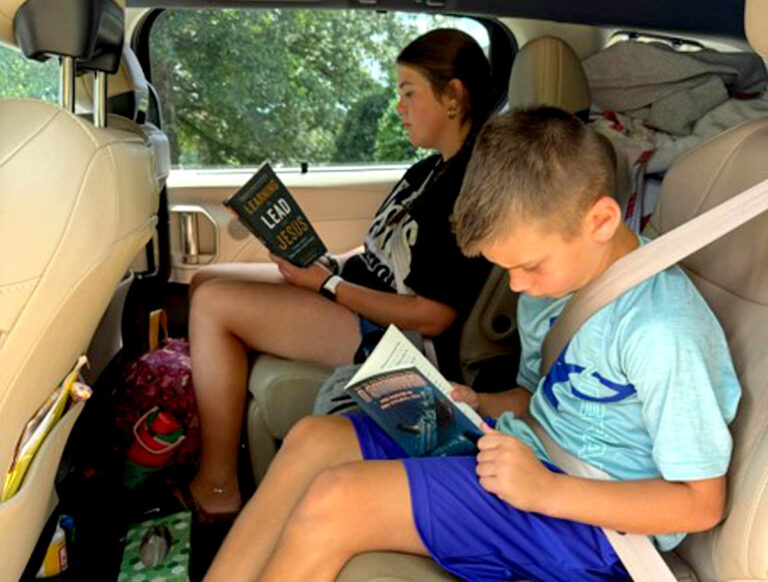
Instead of forcing timed reading sessions, Cates lets her son choose books that genuinely interest him— “Even if the books are about Fortnite,” she said, “I let him read about his interests.” On a recent drive to Nashville, she simply encouraged him to read until he felt like stopping.
“He read the entire book,” she said. “He was so proud he called his Nana to tell her.”
For Cates, creating readers begins with modeling the habit ourselves.
“When you’re waiting at the doctor’s office,” she said, “pick up a magazine instead of your phone. Begin modeling a culture that strays away from the digital and back toward books.”
Rachel Kimmel, History Department Chair at Lakeway Christian Academy, believes reading extends far beyond novels for adolescent readers. That conviction doesn’t end when the school day does. Each morning, she begins her day by reading the newspaper, modeling the habit for her young daughter, Matilda, who has become her favorite crossword puzzle partner. It’s a simple tradition, but one she hopes teaches her daughter that reading isn’t just something students do for school—it’s a way of engaging with the world.
She encourages her students to read newspapers—not simply to stay informed, but to broaden the way they think.
“Our phones create algorithms that feed us more of what we’ve already shown interest in,” Kimmel said. “Kids never read anything different if we don’t model picking up newspapers, books, and living a life of literacy.”
She worries that social media often narrows perspectives rather than expanding them.
“I don’t want the algorithm picking what I read,” she said.
Unlike a social media feed, a newspaper places stories side by side that readers might never choose on their own. A front-page story about a city council meeting sits beside a feature on a local family, coverage of high school athletics, business news, or events happening just down the road.
“Those stories don’t simply inform a community—they connect one,” Kimmel said.
If educators are right, perhaps the better question isn’t simply how we raise readers. It’s how we raise children who know how to slow down, pay attention, and remain curious about the world around them.
Arrowhead Church Pastor Ben Shoun and his wife, Sara, parents of two teenagers, have made cultivating a love of reading a family tradition. Each January, every member of their family chooses a “Book of the Year” for one another. Everyone spends the year reading the books they received, then discusses them together.
“Our goal was always to complete the books before the calendar year ended,” they shared. “It provided opportunities for discussion about what we enjoyed reading.”
Surprisingly, the challenge wasn’t just for the children.
“It was a challenge not for the kids but for us too,” Sara said. “Even if you like to read, you can stick to the same kind of books. With this, the kids pushed us to read books we might not choose for ourselves, and vice versa.”
Perhaps that’s one of reading’s greatest gifts.
Books introduce us to people we’ve never met, places we’ve never visited, and perspectives we might never have encountered otherwise. Newspapers connect us to the people and places we call home. History reminds us where we’ve been. In a world that constantly asks us to scroll faster, reading invites us to slow down, think deeply, and pay attention.
Cates says, “The more informed you are, the easier everything becomes.”
Perhaps rebuilding a culture of reading won’t begin with a new curriculum or another educational initiative. Perhaps it begins with something much simpler.
A parent opening a novel after dinner. A family discussing a newspaper article over breakfast.
A child discovering a favorite series at the library.
A family road trip where books replace screens, at least for a little while.
Children rarely become lifelong readers because they’re told to read. More often, they become readers because someone they love already is.
When I think back to my childhood, I don’t remember my dad telling me to read. I remember watching him do it.
I remember newspapers spread across the kitchen table—Maxwell House coffee brewing before sunrise. The morning news quietly playing in the background. I remember a home where paying attention to the world wasn’t assigned—it was simply modeled.
Looking back, I realize my dad never told me to love reading. He simply showed me how. Maybe that’s how we rebuild a culture of reading. Not by asking children to do something different, but by showing them something worth imitating. One page, one newspaper, one story at a time.