Learning to Fly

From the earliest recorded history human-kind has envied the flight of birds. Early attempts were made to achieve flight, but none proved successful. This desire was finally achieved in 1783 when Etienne Montgolifer was credited with making the first manned flight in a hot air balloon. Balloon flights would become quickly popular with the population while a balloon would also find a military use during the French Revolution.

During the American Civil War both the Confederate and Union sides would find uses for balloons, which would extend through the two World Wars. Between the two wars, Germans would produce motorized zeppelins to carry people across the Atlantic Ocean. That would cease when the hydrogen gas inside the Hindenburg would explode in New Jersey in 1937, leading to the death of a number of passengers. Today, balloons still fill purposes that include weather study, advertising and enjoyment.

Along with balloons would come winged gliders, which would soon be manned. While gliders would first be restricted by design and weather, the search for a powered glider continued. While several parts of the world were involved in this search, our small local area would have a part in the quest for powered flight.

The Panther Springs area had set along the trail leading to Knoxville. That trail would soon become the Great Stage Road, now much of U.S. Highway 11E, and had seen early English-speaking settlement which for a while had included young David Crockett. By the coming of the mid-1800s Panther Springs had grown into a prominent community of prospering farms, along with a church, school, store, an inn and the coming of an academy. Storekeeper Marcus Murrell would be a prominent Panther Springs store keeper who had a very bright young son, Melville, who was born in 1855.

At age 6 and with the coming of the Civil War, young Melville would witness soldiers passing through and also fighting around the community. A marker in a local church cemetery still notes a mass grave of those unfortunate young soldiers. A soldiers’ trench would be above the springs. Those local times would be well recorded in teenaged Kate Livingston’s diary. In 1865 10-year-old Melville and the rest of the country would hear the news that President Lincoln had been shot and the supposition was that the crime had been committed by an actor.

With the coming of the railroad just prior to the war, and with a stop was made in the then-small town of Morristown, that town would eclipse the business coming into Panther Springs. However, Panther Springs would also rebound following the war. As the storekeeper’s son young Melville would have a more privileged life than the labor expected of a farmer’s son. Instead of field work, the gifted young Melville would read a lot, work around the store and would enjoy time in his father’s workshop.

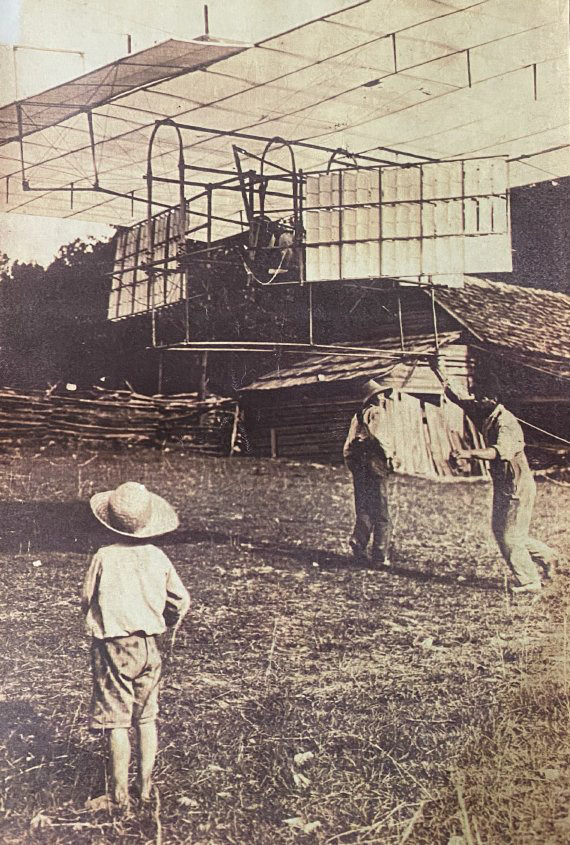
During his time in the workshop, Melville would study how his father’s tools worked and think of ways to improve them, while also coming up for ideas for new tools and pumps. His mind would often move to the buzzards flying overhead and he would study their movement and the air flowing around their while trying to imitate that with curved cabbage leaves. While a proper and light enough combustible engine was not available at the time, Melville reasoned that he could build a human- powered flying machine and went to work on that dream.

The then-21-year-old Melville would then take the idea of a glider and add smaller wings with flaps that would close on a downward thrust and open on an upward movement. Aided by a strong fellow who with the use of hands, feet and pulleys to pump those flaps, Melville’s aircraft that would fly 300 feet in 1876. He would register his craft with a U.S. patent for The American Flying Machine in 1877, and would be offered a then princely $60,000 for those patent rights, which he refused.

Further improvement on his airplane would require funds and advanced materials, leaving Melville to store his craft in a barn. Parts of his machine would find its way to the Smithsonian Museum, and later to the Rose Center in Morristown. He had earlier corresponded with the Wright brothers who would be credited with the first powered flight. Melville’s attention then would become directed to the ministry.

As time passed Melville would be disappointed to see airplanes dropping hand grenades in a North African conflict, with bombs and machine guns being added to airplane armament during the first World War. In the meantime, he would press on with his ministry as a circuit riding Methodist preacher for 45 years. Several early subjects of this column would recall Rev. Murrell visiting their homes. Not long before his passing in 1933 and never having driven an automobile, Melville would take his first ride in a motorized airplane.

Following Melville’s manned flight, other local interest in flying machines would continue.

Grainger County lawyer John Crozier, Jr. had begun working on a flying machine in the 1890s in which he would take several glider flights in the Thorn Hill area. He would exhibit his paddlewheel propelled machine in local areas and was looking for a light engine for his craft when he was shot and killed in 1901 in a legal dispute before he could complete his airplane.

Local aviation would find another hero when Evelyn Bryan Johnson would come to manage the Morristown Regional Airport in 1953, which at the time was a grass strip with a small maintenance hangar and an office. Born in 1909, Evelyn had taken flying lessons in 1944 while her husband Wyatt served in the Army Air Corp during World War II. As a flight instructor she would be listed as the world’s oldest flight instructor and serve in that role until she was 96 when she was injured in an automobile accident.

Evelyn’s remarkable aviation career would see “Mama Bird” logging seven years of flight time, which, along with her other achievements, would place her in the National Aviation Hall of Fame. Evelyn would pass away in 2012 at the age of 102. The current Morristown Flying Service field now carries her name along with that of Tommy Moore, another aviation pioneer.

As the new century appeared, this area would continue its aviation role when a Morristown man Arnold Bunch, Jr., would be promoted to Four-Star General, the nation’s highest military rank. Bunch would receive his commission at the Air Force Academy, the first of his military and civilian schools that would follow.

His career would see him serving as a test pilot followed by other critical jobs before taking command of the Air Force Material Command where he would oversee 80,000 personnel. Bunch now serves as Superintendent of Hamblen County Schools.

The future of local aviation is in good hands with the local Experimental Aircraft Association 1474, led by Karen Hughes-Collins. EAA Chapter 1474 has taken the challenge of teaching some local teenagers to build a flying airplane with their own hands. Those students are closely directed at the airports Aviation Learning Center by a group of top-grade aviation mentors who demand precision work. At the time of this writing the plane is nearly completed and is ready for its first flight.

As soon as the plane takes to the air, those young people can look over a very short distance to see the home site of Melville Murrell.

Melville would be proud.