Public safety leaders express disappointment at budget changes

Public safety is a difficult thing to budget for — here is a tension between providing the best service possible for voters and finding the revenue to make it possible and the Hamblen County Commission is trying to find the right balance but the recent budget committee meeting exposed growing concerns that staffing shortages, employee turnover and funding pressures are affecting agencies ranging from the Sheriff’s Office and E-911 to volunteer fire departments.

At the Monday meeting, representatives from the three services argued that funding challenges are making it difficult to recruit and retain employees and volunteers.

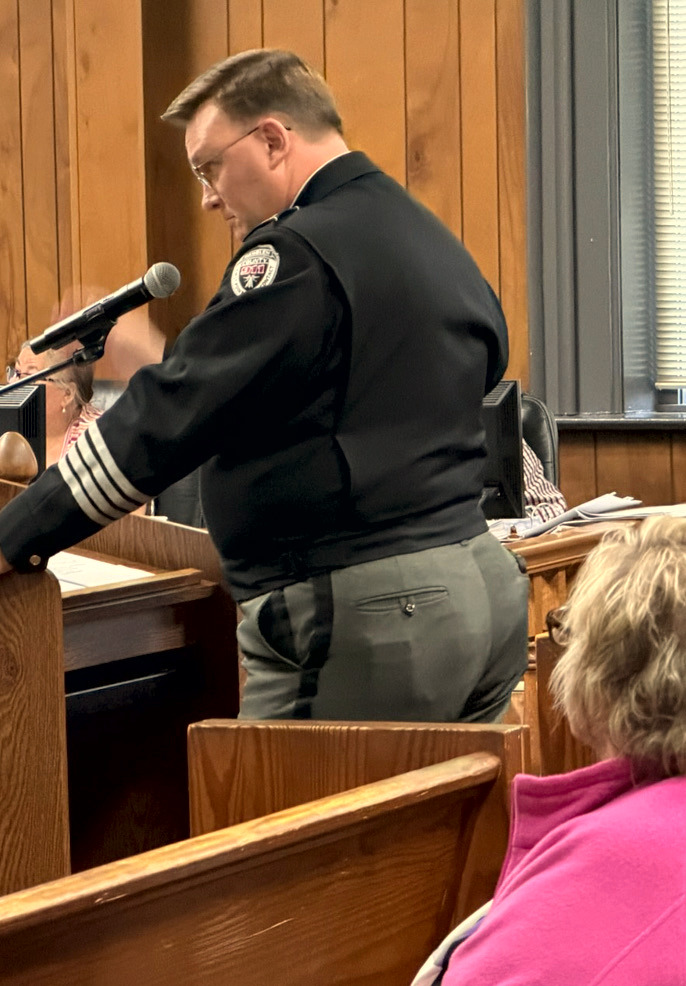
“I’m losing seasoned officers,” Hamblen County Sheriff Chad Mullins said. “There’s a domino effect all the way down to a patrol officer… I’ve got to move a court security in a pro position. Then I’ve got to move a jail officer up to court security. That’s nine weeks of police academy. That’s 320 hours of FTO training before they can even go out on the road themselves. And then, at best, they’re inexperienced.”

The turnover rate in the county has been heavy and in the last year, and just the Sheriff’s Office has seen the turnover of 17 jail employees, 7 SO employees, 1 courtroom officer and a work release/probation employee.

Mullins acknowledged the Hamblen County Commission has made a serious effort to address compensation, but he’s still losing good employees to other area agencies.

“The county, this commission here, this body, the past four years has been good to us, but we’re still behind and it’s showing,” he said, and talked about how at a recent meeting the budget committee seemed ready to propose a 10% raise for HSCO employees that was then, at the Monday night meeting reduced to 5% to match cost of living adjustments for other county employees.

“It’s very frustrating, very disappointing,” Mullins said. “I was there advocating for the Hamblen County employees from the Sheriff’s Department that deserves a 10% raise because our pay is down from surrounding counties.”

Documentation of prior years’ raises bear out that this current Commission has been designating raises of 10% in 2023 for Sheriff’s employees (excluding clerical) and a 10% raise for correctional officers (verses 7% for others) in 2026. Those moves followed a 15% raise for public safety officers in the HCSO in 2022.

One of the issues surrounding those raises not meeting the levels in other counties/communities is that from 2007 to 2016 there were no raises for county employees that exceeded 3% and four of those years no cost of living adjustments were implemented at all.

Consequently, due to the compounding noneffects of missed earlier years’ raises for all county employees including public safety, the current Commission is faced with more pressure than it would have had otherwise.

At the Monday night meeting there were several Hamblen County volunteer firefighters present to speak about the prior budget meeting in which Commissioners discussed a possible cut to the departments as a way to find money in the budget. They eventually ended up deciding to fund at last year’s levels, but after the volunteer public safety officers spoke up, they ended up getting $5,000 more dollars per department for the fiscal year’s 2026-2027 budget, bringing the total to $80,000 per department.

At the June 4 budget meeting there were concerns from Commissioners that departments spent too much on recreation.

South Hamblen VFD firefighter Renee Jarnigan, along with West Chief Mark Hickman and South Chief Kevin Jarnigan, pushed back during public comments at the June 8 meeting.

“The suggestion that departments spend more on recreation than training fails to recognize the realities of volunteer recruitment and retention,” she said. “Those activities help maintain morale, recruit volunteers, and sustain departments that are already struggling with dwindling manpower. A volunteer fire department cannot function without volunteers.”

She spoke about the service the departments provide.

“Volunteer fire departments save taxpayers millions annually by providing professional emergency response services at a fraction of the cost of fully paid departments,” she continued. “It is easy to question funding from a meeting room. It is much harder to stand on the side of the road at 2 a.m. in the rain while trying to help save a life while balancing your family, your work, or your volunteer service.”

One more public safety professional spoke at the Monday meeting.

Hamblen County Emergency Communications District Director Eric Carpenter argued that local governments are increasingly being asked to shoulder costs that state officials declined to address earlier this year. Carpenter pointed to Gov. Bill Lee’s veto of legislation that would have increased Tennessee’s 911 surcharge from $1.50 to $1.86 per month, a move emergency communications officials across the state supported as a way to help fund technology upgrades, training and staffing.

In a statement released after the veto, Carpenter said the state had decided to burden local communities with the responsibility of funding 911 at proper levels.

“No doubt this will create a significant and unavoidable strain on local budgets that the legislature tried to avoid,” he wrote.

At the June 8 meeting Carpenter went over all of the things that go into operating a 911 center, and he pointed out that Hamblen County 911 was operating at lower levels than surrounding counties and had not pursued local funding aggressively last year because it was not expected the state funding bill would be vetoed, especially, as it turned out, after the legislature passed the measure overwhelmingly.

Greene County 911 receives $1,109,750 in local funding and Jefferson County 911 receives $1,078,952 in local funding.

Hamblen 911 receives $571,000 from Hamblen County and the City of Morristown.

“When it comes right down to it, the basic elements of public safety are that: one, you need someone to answer the call, two, you need someone to send help, and three, you need someone to go and deal with the issue,” he said. “Your 911 system is the first two of those.”

His comments echoed concerns raised by the Sheriff’s Office and volunteer firefighters that public safety agencies are facing growing pressure to maintain service levels while competing for employees, volunteers and funding.

John Gullion
John Gullion
Articles: 199