Sculpting a Story: Back When by Jim Claborn

Jack and Louise Felknor Britton of west Morristown hit the jackpot with their two sons, David and Don. Both sons would grow to be productive and multi-talented adults. Father Jack would work at the Pan America (Amoco) office until moving to a job at the Morristown Housing Authority where he would pass away from a heart attack at age 48.
Mother Louise taught piano lessons and continued teaching piano lessons after her husband’s passing.

“She taught piano to hundreds of students, but when she tried to teach David and me those lessons never took hold,” Don smilingly recalled.
Son David’s business leaning appeared early when the family’s apple tree, loaded with ripe fruit, fell over in their yard. Not one to miss an opportunity, David brought in young neighboring boys to pick up and load the apples into his little wagon which he pulled the wagon around the neighborhood and sold the apples. He would later take his business drive into a successful career in real estate and real estate appraisal, while his second talent would be restoring older classic vehicles.
Don, 2½ years younger than his brother, starting out as a 4or 5-year-old youngster drawing pictures of horses on white cardboard dry-cleaning panels while his aunt Ella Felknor would coach the young fellow on his artwork. Young Don would also soften crayons in the sun until they were pliable enough to mold into little sculptures.
He would continue his artistic drive by earning a degree in art and leading the Volunteer Blind Industries to become a successful business. During that time, Don would also produce top-grade detailed prints each of which would tell a story. His earlier drawings had started by copying pictures from books and would evolve into highly detailed and historical themed paintings, each of which told a story.
While growing up on the western end of Morristown, both brothers would attend the former Rose School with principal John Falls, move on to junior high and graduate from the then Morristown High School where Don graduated in 1966. During his high school years, he would work for the R.M. Rogers clothing company along with shoeing horses after school and on weekends.
Following his graduation, Don would attend Carson-Newman for two years before moving on to the University of Tennessee where he would graduate in 1970 with a BFA degree in Commercial Art. During his college time, he would earn money by selling his art.
“I had never taken an art class in high school, and that was a big mistake,” he told. Having intended to become an art teacher, his degree didn’t have the necessary teaching credits, leaving Don to return home to find work.

In 1972, Don was hanging around Pearson’s Car Wash on Cumberland Street when Mr. Pearson loaded Don into his car and took him to the Volunteer Blind Industry’s factory where would meet the manager, Kemp Newman. At the time, one of the VBI’s salesmen was ill and there was a need for a mattress salesman. Don would begin a career at VBI selling mattresses for three months to the company’s customers.
“The company was struggling when I got there,” Don would tell. “We had five- or six-blind workers. Mr. Newman and I went to a meeting in Chattanooga where I became a trainer. We started a rehab program available to anyone in the state. People who have never had sight and have no concept of it have learned to accept it and adapt, while those who have had a visual history and had early experienced sight been much easier to train.
“Many of those who had graduated from the training program would go to work at VBI,” he continued. “I’d had some tough and serious English teachers at junior high and high school and that made it much easier to write many grants while I was working at VBI. The program and grants allowed us to eventually grow to 250 employees of which 150 were blind.
During Don’s time at VBI, sales would go from a half million to $17 million. He would serve for 43 years with VBI before retiring as the company’s executive director.

Throughout his VBI career, Don would continue his lifelong love and enjoyment of art. During the ‘80s and ‘90s he would do pencil drawings some from photos of old home places and such that people had brought to him.
“I would find pictures in books and try copying them,” he said.
That endeavor would see Don producing over 100 prints and paintings of a commercial grade.
During his time at UT, Don had met his roommate’s sister, Martha McMahon. The two would be married in 1973 and have son Jack. Martha would have a career as a rehab counselor. The couple now lives in a handsome home in a still un-crowded section of east Hamblen County with their son Jack along with their dog Teddy Bear and their horse in its barn behind the house.
Early crayon sculpture had evolved into beeswax sculpting which would leave a model that couldn’t be properly cast. While at VBI, Don would sign up for a foundry class with Walters State Community College’s Bill Carl. A fellow in Jonesborough had earlier taught Don resin casting. That, along with Carl’s class, had taught Don the process of putting a clay-modeled piece into a mold before firing them into a solid object that could be painted. He would also learn to cast objects in bronze, which would allow him to broaden his sculpting interest.

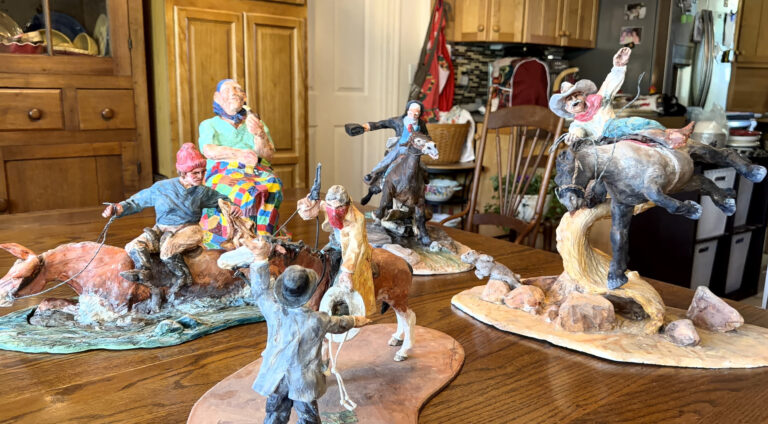
With an affinity for the history, resilience, and independence of Depression-era Appalachians, Don terms his works as “Feedsack Philosophy.” A number of his highly-detailed sculpted works include a Kentucky book lady delivering books by horseback to rural families. “Yarn Spinning” shows a tale teller, while another is a resting “Granny Woman.” One features a robbery at a toll road, while others depict a doctor on horseback rushing to a patient and a rider’s horse being spooked by a rabbit. Each of his works tells an evolving story.
Along with his sculpting, Don has also published a book on cowboy poetry and an early pottery class has found him crafting pottery. His pottery process includes placing a work in a low temperature kiln fire for about five days to create a permanent product which is then painted or glazed if being used for holding food products.
“I’ve always enjoyed art and want my art to tell a story where someone will look beyond the paint,” Don would tell. “I’m a storyteller with a pencil and a piece of clay. An averaged drawing can be saved by painting it. Marketing my art is an enjoyable sideline. My works have been displayed at Morristown’s Mountain Makin’s since its beginning and I hope to be there this year”.
Don will be featured this Sunday, June 7, at the Rose Center from 2 p.m. to 4 p.m. with an assortment of his works. Just meeting Don is an adventure.