Suffragette

From “Perfect 36” to the Future: Women’s Suffrage Museum rising in Knoxville
Austin Dalton
Grainger County Journal
KNOXVILLE – In 1920, Tennessee became the final state needed to ratify the 19th Amendment, securing voting rights for women nationwide and earning the title “Perfect 36.” More than a century later, that decisive moment is shaping the future once again as the Women’s Suffrage Museum prepares to open in downtown Knoxville.
For Wanda G. Sobieski, president and founder of the Suffrage Coalition and president of the Women’s Suffrage Museum, the journey has been decades in the making.
“I served on the 75th anniversary of suffrage statewide Commission for that commemoration in 1995,” Sobieski said in a recent phone interview. “And at that time, I was really surprised to learn that there was absolutely nowhere that I could find in this entire state a plaque, much less a bust or a statue honoring the women of the South, in particular, who, under very adverse conditions, worked hard to get Tennessee to be the final critical vote that gave us a right to vote.”
She was even more surprised, she said, that many Tennesseans were unfamiliar with the dramatic final vote that ratified the amendment.
“And more surprised I was that people didn’t even know about the Harry Burn story and how close it was and what a dramatic moment it was when Tennessee finally did the right thing, and got suffrage over the goal line,” she said.
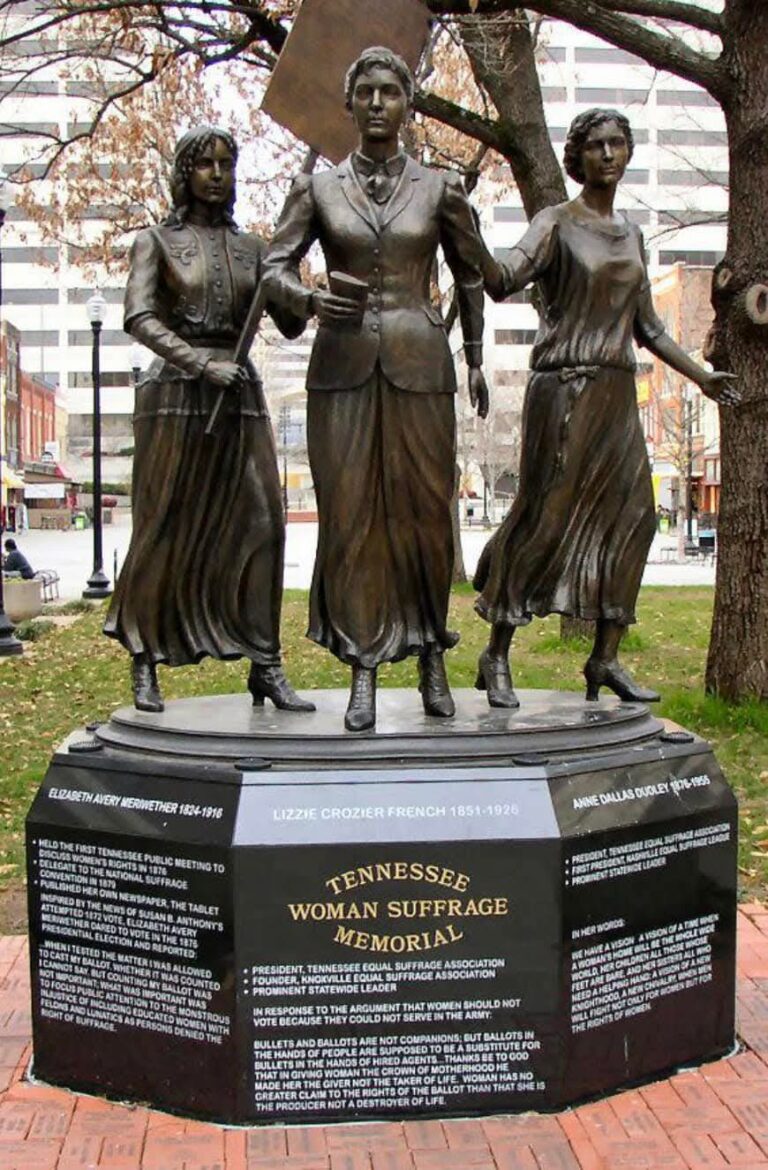
That realization led to the formation of the Suffrage Coalition in 1995 and ultimately to the installation of the Tennessee Woman Suffrage Memorial in Market Square in 2006, followed by the Burn Memorial in 2018 honoring Febb Ensminger Burn and her son, Rep. Harry T. Burn.
Now, the work is entering a new chapter.

The Women’s Suffrage Museum, located at 706 South Gay Street, has already been purchased and paid off. The Coalition is under contract for the adjacent 708 South Gay Street building, which would create more than 20,000 square feet of exhibit space. Construction is expected to begin in early 2027 with a target opening in Spring of 2028.
“You know, we think of Tennessee and have for generations thought of Tennessee as East Tennessee, Middle Tennessee, West Tennessee,” Sobieski said. “And certainly the home of Febb, the mother who wrote the letter that changed our world, and Harry Burn, who, fortunately listened to his mother and broke the tie that made us the state that gave the final ratification.”
With both memorials already in Knoxville, she said, the city felt like a natural home for the museum.
“Well, what I expect is, based on years of doing slide shows and programs on suffrage, I expect people will be shocked to learn what opposition there was, and the extent of the opposition, the depth of the opposition, and sometimes the reasons for the opposition,” Sobieski said. “The efforts that it took and the variety of directions that the suffragists came from, at least the variety of tactics, a variety of points of view in trying to make the arguments to support suffrage. I think will be both educational and inspiring.”
She noted that when the movement began, married women could not own property, had no legal rights to their children and possessed no voice in government.
“It’s just, it’s amazing to think that women who had no right to their own children and their husbands could give their children away when this all started,” she said. “Just the extent of the restrictions on the women beyond the right to vote, I suspect will be surprising to many people.”
Contrary to what many learned in school, Sobieski said suffrage was not granted suddenly or easily.
“When I was in high school, the only thing in our history book about suffrage was one single sentence that said in 1920, Congress gave women the right to vote,” she said. “And sometime later, I learned that really, it wasn’t quite so easy. Congress didn’t just suddenly remember it left women out, all those years, and that in fact, it was a 72 year battle for women to get the right to vote.”
Measured from the Seneca Falls Convention in 1848 to ratification in 1920, generations of women passed the torch forward. Only one attendee of that first convention lived long enough to cast a ballot in 1920.
“It was generations,” Sobieski said. “It wasn’t one generation that did it.”
Central to the museum’s mission will be more than 1,000 suffrage-related artifacts, many preserved by Sobieski herself while researching primary sources.
“We have collected the artifacts initially because it was so hard to find primary sources on suffrage history,” she said. “The way historians try to make sure that they’re accurate is to look at what was said and done at the time, and who was there, who saw what happened and not speculate.”
Among the collection are guest chairs from Harry Burn’s legislative office, original letters signed by Susan B. Anthony, correspondence and books from Carrie Chapman Catt and early volumes of History of Woman Suffrage inscribed by Anthony herself.
“This will not be the kind of museum that is just artifacts and storyboards where you have something on display and then read a board that tells you about that item on display,” she said. “We hope to make this a much, much more dynamic museum.”
When the Harry Burn letter was displayed during the unveiling of the Market Square memorial, visitors responded deeply.
“I watched as people came by and read that letter and wept,” Sobieski said. “Something about the presence, just being in the presence of something like that makes it more real.”
“There’s some magic in being in the presence of them,” she added.
A Story Close to Home
The suffrage struggle was not confined to Nashville or Washington. Sobieski pointed to Morristown’s role in the movement, where Rev. J.C. Price invited Knoxville suffragist Lizzie Crozier French to speak from his pulpit. In 1914, during a statewide convention there, opponents reportedly climbed onto a roof and poured sulfuric acid through a skylight in an attempt to disrupt proceedings.
“But that didn’t even stop the convention,” Sobieski said. “They just went on.”
As the nation approaches another election year, the museum’s mission feels particularly timely while remaining nonpartisan.
“History teaches us so much about our future, about what people are capable of, about what it takes to get things done, about our own values, and how those values can erode over time, or they can be improved over time, depending on how we direct our own citizenship activities,” Sobieski said.
The Women’s Suffrage Museum aims to preserve the past while encouraging civic awareness and participation for generations to come.
Fundraising is ongoing for the expansion, with leaders working toward paying off the second building and moving into full exhibit design and renovation. If the schedule holds, the doors will open in Spring of 2028.
“It’s hard for me to believe to understand how controversial the thought that women would have the right to vote and be full citizenships was back then,” Sobieski said. “And what it took to change the minds of the whole country is enormous.”
More than a century after Tennessee carried suffrage “over the goal line,” that story is finding a permanent home, one that invites reflection, humility and renewed appreciation for the generations who fought to ensure that every voice could be heard.